


Free Access | August 2021
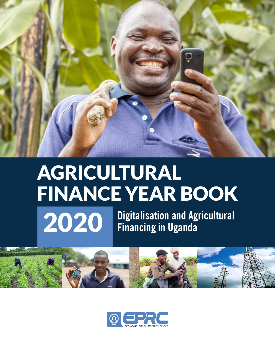
Agricultural Finance Year Book: Digitalisation and Agricultural Financing in Uganda
Authors/Editors: Economic Policy Research Centre
Abstract:
The 2020 Agricultural Finance Yearbook, which is the tenth edition in the series, offers an in-depth analysis of the Agricultural financing landscape in Uganda. The theme for this edition is “Digitalisation and Agricultural financing in Uganda”. The first chapter of the Yearbook includes an analysis of the impact of government’s policy and strategy on the agricultural sector. An important lesson of this analysis reveals that while government interventions such as the Agricultural Credit facility have been instrumental in boosting the flow of credit to the agricultural sector since its establishment in 2009, what remains critical is a comprehensive evaluation and review of the scheme with the aim of expanding and improving its reach beyond financing large scale farmers, processors and guaranteeing grain trading and marketing to encompass more types of Agricultural Small and Medium Enterprises. Secondly, government needs to fully implement the National Financial Inclusion Strategy 2017-2020 to deepen financial inclusion in the agricultural sector. This strategy identifies key aspects that are needed to fully unlock financial inclusion by reducing access barriers, enhancing credit infrastructure, optimising and de-risking digital financial infrastructure, deepen use of financial services (including insurance), and increase financial literacy in the country. Chapter Two of the book chronicles the results of research into recent innovations in support for smallholder farmers and the provision of rural finance. One of the important findings in this chapter is that Government should urgently address issues that place Digital financial services (DFS) transactions under multiple legislations. Existing legislations should also be reviewed so that they adequately cover digital agribusiness. The draft national policy and strategy on agricultural finance should address DFS needs for agriculture and DFS should be fitted into agricultural cycles, agri-business skilling and extension services. In the third chapter, evidence is presented regarding the financing of agricultural value chains. One of the important finding in this chapter is the lessons learnt from Tanzania’s Consortium Model for the rice value chain. The model reveals the importance of policies that enable contract farming business models to thrive and how they can galvanise private sector investments. The Model also indicates how lead firms enable financial institutions to reach and service smallholder farmers and other partners in the value chain. For Uganda to successfully adopt this or other similar models, it needs to; develop a law governing contract farming; eliminate disproportionate concessions or waivers to millers and tariffs (especially on imported rice); and invest in collection of reliable agricultural data. The last chapter in this Yearbook presents interventions aimed at improving the investment climate within select areas of the agricultural sector. A coffee auction arrangement is proposed to enable Uganda coffee to attract export margins similar to those of comparable quality coffee from other countries. However Uganda must; produce sufficient volumes of trades to make a coffee exchange financially viable; strengthen the link between the coffee exchange and its warehouse receipts system (WRS); and discourage cartel formation among coffee buyers.
DETAILS
Pub Date: August 2021
Document N0.: 1
Volume: 1
Published By:
Economic Policy Research Centre