


Free Access | August 2023
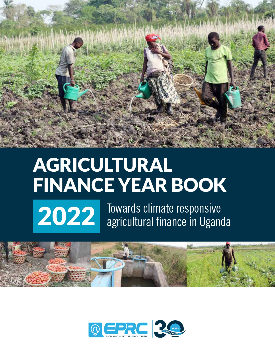
Agricultural Finance Year Book: Towards climate responsive agricultural finance in Uganda
Authors/Editors: Brian Sserunjogi (PhD) , Economic Policy Research Centre
Abstract:
The first chapter of the Yearbook delves into aspects of government’s policy and strategies for providing an enabling environment to support agricultural finance. This chapter reveals that Uganda lacks an elaborate legal and regulatory framework for operationalisation of agricultural credit guarantee schemes and agricultural leases. Particularly, the taxation of agricultural leases in Uganda is not streamlined. And, while the Block allocation product was introduced under the Agricultural Credit Facility (ACF) to target smallholder lending, most of the target beneficiaries belong to Savings and Credit Cooperative Organisations (SACCOs), which are not part of the Participating Financial Institution (PFI) implementation modality. Thus, the ACF eligibility criteria needs to be reviewed to incorporate Tier-4 institutions, including licensed SACCOs. Chapter Two presents recent innovations to support provision of agricultural finance to smallholder farmers. Although these digital innovations have demonstrated great potential to increase credit access for agricultural borrowers, several challenges persist. Considering the implementation of the Security Interest in Movable Property Registry System (SIMPO), the innovation is limited by lack of lender and borrower awareness beyond Kampala. In addition, the Government needs to urgently ease entry integration barriers with the National Identification and Registration Authority database to facilitate digital client verification and application of FINCA’s credit scoring innovation. Besides, effective implementation of the Soma e-learning innovation requires investment into developing local contents aligned with national curriculums, investment in digital literacy and development of digital infrastructure, specifically internet accessibility and power supply in the rural areas. The Third chapter presents critical issues regarding financing of agricultural value chains in Uganda. The evidence in this chapter reveals that input credit financing for the Uganda’s sugarcane value chain is threatened by a persisted withdraw of millers, the erstwhile source of input credit for sugarcane outgrowers. This withdrawal has been orchestrated by a breakdown of the cane registration support system. Considering the rice value chain, effective implementation of the Uganda’s village-based agent model to improve rice productivity requires supporting access to aggregation infrastructure, particularly storage facilities and continued investment in irrigation schemes to reduce productivity loss due to recurrent drought. On the contrary, financing of agricultural value chains through the warehouse receipt systems in Uganda requires reforming the regulations in the Warehouse Receipt System Act of 2006 to allow private entities issue tradeable electronic warehouse as well as putting in place an appropriate legal enforcement system to regulate the quality of warehoused commodities. The last chapter in this Yearbook presents interventions aimed at integrating climate sustainability into conventional agricultural finance. The evidence reveals that financial sector efforts towards climate risk mitigation in Uganda is gaining steam. At the financial institution’s level, several measures have been implemented through internal and external corporate social responsibility and customer relationship management initiatives. To deepen such climate sensitive initiatives at the agribusiness level, Uganda will need to cascade down the Environmental, Social and Governance (ESG) policies that are already being implemented at the financial institution levels, to the enterprise and community levels. The cascading shall involve integrating of ‘green’ contractual clauses by financial institutions and development actors extending support to only compliant agribusinesses. In addition, Uganda will have to underpin the ESG policies by strong operational, monitoring and evaluation frameworks that align with the existing and upcoming national and international regulatory standards.
DETAILS
Pub Date: August 2023
Document N0.: 1
Volume: 1
Published By:
Economic Policy Research Centre