


Free Access | April 2001
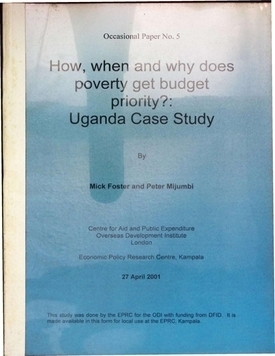
How, when and why does poverty get budget priority?: Uganda case study.
Authors/Editors: Mick Foster , Peter Mijumbi
Abstract:
This report analyzes how Uganda transformed its budget process and institutional frameworks to directly target rural poverty reduction. Led by the Ministry of Finance, Planning and Economic Development (MFPED), the government aligned public spending with the Poverty Eradication Action Plan (PEAP) and the Medium Term Expenditure Framework (MTEF), utilizing innovative mechanisms like the Poverty Action Fund (PAF) to guarantee funding for basic education, primary healthcare, clean water, and feeder roads. Furthermore, over one-third of public expenditure was decentralized to local authorities through transparent conditional grants, significantly improving service access and reducing national poverty rates despite ongoing challenges regarding public sector pay, local governance flexibility, and civil service fiduciary accountability.
DETAILS
Pub Date: April 2001
Document N0.:
Volume:
Published By:
Economic Policy Research Centre