


Free Access | November 2005
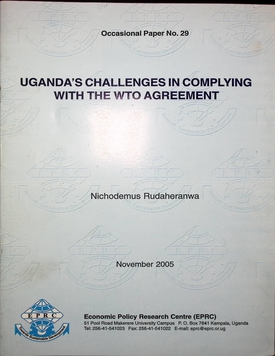
Uganda's Challenges in coping with the WTO agreement
Authors/Editors:
Abstract:
As tariff and tariff-related barriers to trade continue to decline through trade liberalization and regional integration, non-policy barriers to trade like freight costs, standards and quality requirements are increasingly gaining significance. Non-policy barriers to trade are more relevant to agricultural countries like Uganda that are focusing on export of perishables (e.g. flowers, vegetables, fish and fish products, etc.) in markets for example Europe where quality requirements are too stringent before accessing the market. The discussion in this paper looks at Uganda's capacity to overcome trade constraints due to the need for complying with standards by focusing on the WTO Agreement on SPS and TBTissues before and after 1995. Case studies focusing on institutions (i.e. Department of Crop Protection, Department of Fishery Resources, Uganda National Bureau of Standards) responsible for formulating and enforcement are covered in detail to unveil problems relating to mandatory standards and trade in Uganda. It is clear that difficulties facing Uganda in formulating and enforcing process and product standards include institutional weakness arising from inadequate infrastructure and capacities, insufficient technical know-how in standards development processes, little awareness and limited access to Information on international standards among relevant stakeholders, limited participation in intemational standards-setting process, poor coordination among agencies responsible for technical regulations, inadequate funding, and inadequate stakeholder participation in formulation oftechnical regulations. A lot has been done in areas of standardization and quality control, however, more needs to be done. This low institutional and infrastructural capacity clearly calls for further attention in terms offunding and other forms ofsupport that would contribute to reduced trade costs, more trade, employment, income and better welfare of stakeholders in the trade sector.
DETAILS
Pub Date: November 2005
Document N0.:
Volume:
Published By:
Economic Policy Research Centre